The Florence Greenway traverses both history and the contemporary. Today, it’s necessary to interpret the 19th century landscape created by Giuseppe Poggi in the context of the new city-countryside and the desire of citizens worn down by urban stress to return to nature. Urban countryside is therefore a modern answer to the historical city-countryside juxtaposition. Unlike other cities of the world, Florence boasts a perfect and harmonious integration between the constructed, the geologic, and the fertile, and between the natural and the rural that surrounds and embraces the historic city.
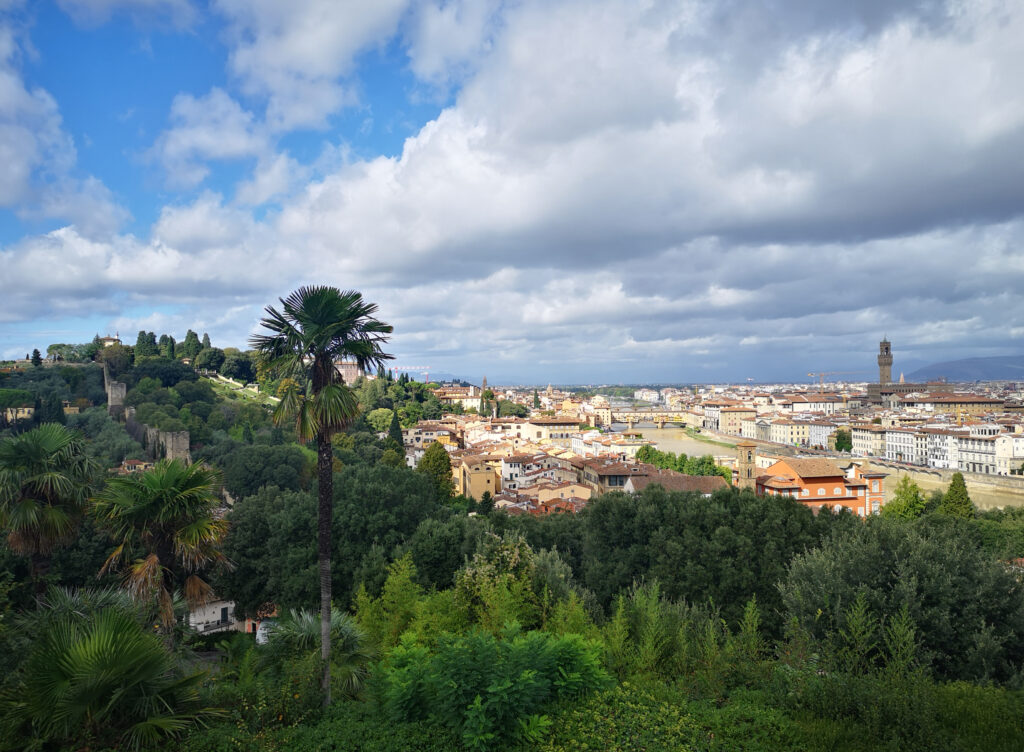
The Florence Greenway is a green, urban, ecological infrastructure intended for cyclists and pedestrians, with several already-existing routes which cross UNESCO sites (Florence Historical Center and the Ville Medicee serial site) and the buffer-zone of the UNESCO Florence Historical Center site for a total of about 15 kilometers.
The main itinerary follows Viale dei Colli, conceived by Giuseppe Poggi, when Florence was the capital of Italy, as an English garden on an urban scale. Today it represents an extraordinary and unique greenway. From Porta Romana to Piazza Poggi, it is an exception walk through the nature and art of the Florentine hills and affords some of the most beautiful views of the city and surrounding landscape.
Florence Greenway’s East route is part of the Grande Greenway, a network of pedestrian paths that encircles Florence and traverses the surrounding landscape. It features an extraordinarily preserved rural landscape near the city, featuring a system of medieval roads that lead to rural settlements and small villages like Corbignano, through Settignano, and finally to Villa Gamberaia and its garden, known worldwide as one of the most beautiful gardens in Italy, a true model of landscape architecture.
The West route connects Villa Careggi with Villa Castello, passing through buildings and gardens that are state-owned as well as private properties. After crossing the bridge over the Terzolle River, the main route continues past the oratory and the Loggia dei Bianchi complex, heading west along Via della Quiete and Via di Boldrone, Via della Petraia, and Via di Castello. This route divides the city from the plains and the hills dotted with villas, some of which are private. Numerous gardens and agricultural landscapes, which have retained many of their original features, can be traversed from east to west. Since these are mostly state-owned buildings and complexes, managed by the General Directorate of Museums of Tuscany, this particular Greenway project was developed in collaboration with the Ministry of Culture office.
Maria Chiara Pozzana
President of the Cultural Association Firenze Greenway